
Why I couldn’t go back—even after he got clean.
It’s the question that follows women like a shadow after divorcing an addict.
Why didn’t you know?
If it was that bad, why didn’t you leave sooner?
Why did you give him so many chances?
Why not give him another chance now—he’s clean, isn’t he?
Those questions assume something that isn’t true: that clarity exists inside chaos.
When addiction lives in your home, it doesn’t arrive all at once. It doesn’t always come crashing through the door in one dramatic moment that makes everything obvious. For many of us, it’s years of subtle shifts—things that slowly change until you don’t even recognize what “normal” was supposed to look like. And when much of what you’re living has never been normal, you don’t have a baseline to measure against.
Dissociation becomes the requirement for survival.
Not because you’re weak—but because staying means your nervous system has to adapt. You compartmentalize. You minimize. You explain things away. You focus on keeping the peace, protecting your children, maintaining the household, and holding everything together while pieces of yourself quietly disappear.
Until it doesn’t work anymore.
The day I left was filled with pure shock.
There was a moment—inside our four walls—where everything changed. The dissociation snapped, just long enough for clarity to cut through. A single, undeniable knowing: this is not okay.
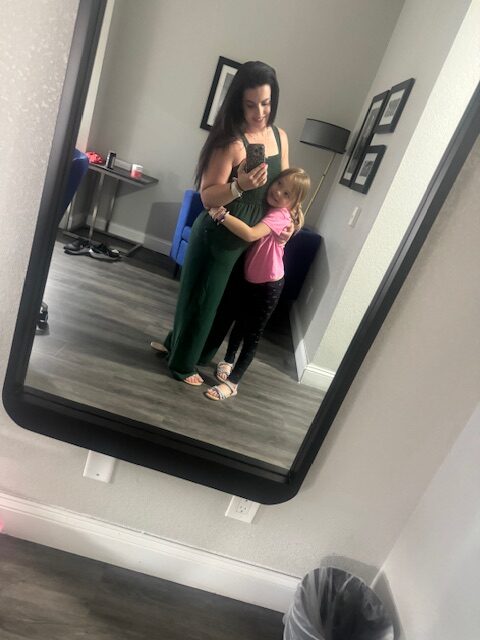
I walked out of the home I had built for fourteen years with two bags. A child who had just turned six. And the terrifying realization that the man I had married might die before he ever got help.
Closing that front door meant accepting something no wife or mother should ever have to accept—that I had to be okay with the phone call that might come after. That I had to be okay with choosing.
Because the choice wasn’t comfort versus discomfort.
It wasn’t loyalty versus selfishness.
It was him or my six-year-old.
That choice was never in the vows.
It was never part of the agreement.
It was never part of the happily ever after.
When people ask me how I left, they assume there was a plan.
The truth is, it was God.
It was a spiritual awakening I didn’t yet have language for. I moved with precision while understanding almost nothing about what was really happening. I didn’t know where I was going. I didn’t know how it would work. I only knew one thing: I needed to get out.
I left with a tracker in my car.
With threats of an Amber Alert being called on me.
With constant insistence that none of this was drug-related—that it was all in my head, that I was crazy, and that he would make the world believe I was crazy for leaving. That I would lose my daughter. That I would lose my career.
I reread those messages sometimes now and think, Wow. Why did you believe he had any real control?
But I also remember what it felt like to read them then.
I remember being so disoriented by the lies that I called the police on myself—trying to anchor reality somewhere outside of my own mind.
Because when you’re living inside a truth that no one else believes, where do you start?
Of course you fear the alternative.
Fear becomes the last thing keeping you still. Fear of being wrong. Fear of losing everything. Fear that maybe they’re right and you’re imagining it all.
So yes—it’s true.
When he got clean, I didn’t give him a “fair shot.”
But there isn’t a line in the sand where sobriety erases years of destruction. There isn’t a rule that says because you’re clean now, I must forget everything that happened while you weren’t. Over years of addiction, things happened. And because of them, I changed.
When I finally got out—when my world flipped upright again—there was a kind of detox that no one talks about. I wasn’t just healing from him. I was healing from what had been toxic for so long that I didn’t even recognize myself inside it.
And in that space—quiet, raw, and finally clear—I felt God tell me something I couldn’t ignore:
I couldn’t go back.
I couldn’t throw away the chance He had given me to get out. I couldn’t return to something that had nearly destroyed me just because it had learned how to look different on the outside.
Leaving wasn’t betrayal.
It wasn’t bitterness.
It wasn’t punishment.
It was obedience.
It was survival.
It was choosing my child—and the woman I was becoming—over a story that was never meant to end the way it began.
And that is not shame to carry.
I could have stayed quiet.
I could have never spoken about what happened. I didn’t have to publicly open my world to anyone. And you can only imagine—what I’ve shared here barely scratches the surface. There are deeper layers, more twisted realities, and entire chapters I will never speak out loud. Things no one will ever know.
But when your reality has been twisted for so long, silence doesn’t bring peace—it keeps you trapped. Sometimes you have to say it out loud just to see it clearly again. To hear your own truth outside of the fog. To put it back into proportion. To remember what’s real.
And more than anything, this is about freedom—freedom from this being our story.
His choices are not our shame.
We are not what happened to us.
We are not a broken family.
We are healing.
We are growing.
And we are chasing everything we deserve out of this life.
What Comes Next
If you’re standing in the aftermath of something you never asked for, you are not behind—you’re rebuilding. There is life after survival. There is purpose after chaos. And there is a future that gets to be defined by what you choose next, not what you endured.
If you’re in a season of transition and quietly wondering what comes next, know that rebuilding doesn’t always mean starting over — sometimes it means creating alongside your healing. I’ve built something that gave me freedom, income, and the ability to be present for my child during the hardest chapter of my life.
If you’d like to explore that path, you’re welcome here.